Service Catalog & Map

The map draws itself from the spans

There is no topology to declare. Maple reads parent-child relationships out of the traces you already send, so a new service appears on the map the first time it is called.

The surface

Twelve services, one table

Latency percentiles, error rate and throughput per service, over the range you picked. Sort by p99 and the row that needs you is the top row.
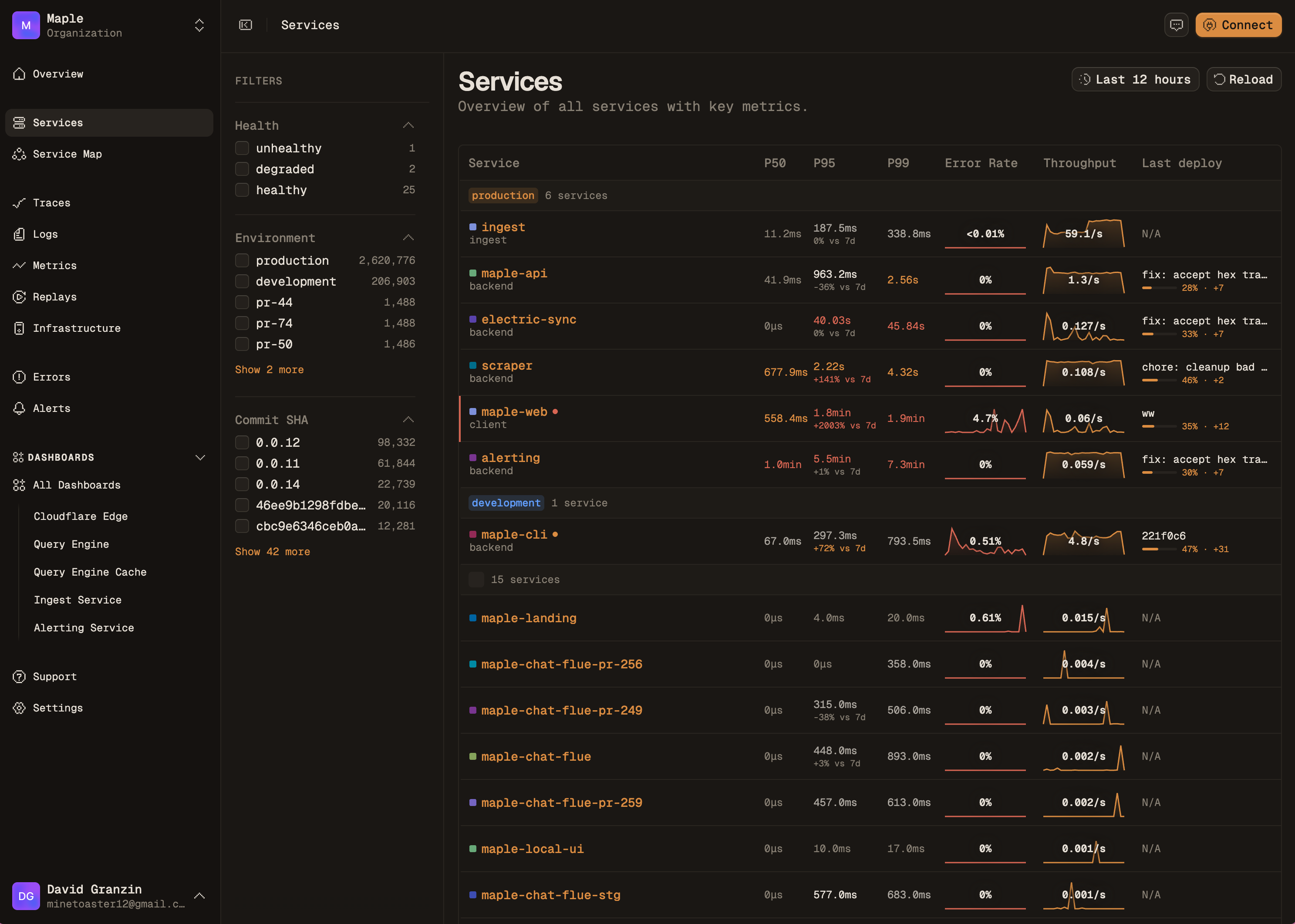
The service catalog listing latency percentiles, error-rate trends and throughput per service
/services 12 services · env production
topology
derived from spans
nodes
service · db · cache · external
edges
parent → child
per.service
p50 · p95 · p99 · error% · req/s
colour
16 hues · service identity

In motion

Traffic, moving

Each node carries its request rate, error rate and average latency. The flow along an edge is that edge's traffic, not decoration.

service map · last 60s LIVE
2.8k req/s edge req/s 12.4k err% 0.1% avg 8ms checkout-api req/s 4.2k err% 0.3% avg 24ms cart-svc req/s 8.1k err% 0.1% avg 18ms auth-svc req/s 4.2k err% 0.0% avg 6ms pricing req/s 2.8k err% 2.4% avg 142ms payments req/s 1.1k err% 0.5% avg 38ms redis DB calls/s 18.2k avg 2ms postgres DB calls/s 6.4k avg 14ms
8 services · 8 edges · 60s window pricing-svc · p99 +18% vs 1h ago

What it does

Reading the neighbourhood

edges
Edges are real calls
Every line between two nodes is a parent-child span pair that actually happened, carrying its own request rate and error rate. Nothing on the map is declared.
db.system
Databases and caches too
Client spans become nodes, so Postgres, Redis and every third-party API sit on the map beside your own services with the same latency columns.
1-hop / 2-hop
One hop, two hops
Focus a node and the map collapses to what it talks to. A forty-service estate becomes the six services that matter to the question you are asking.
service.name
Colour by identity
Each service holds one of sixteen hues, and holds it everywhere — the map, the waterfall, the charts. Colour means which service, never how healthy.
service.version
Deploys on the same axis
A service's detail view marks releases against its latency, so a step change lines up with the version that introduced it instead of a hunch.

Keep going

Surfaces that share this data

Point OTLP at Maple.

One endpoint, one key. Traces, logs, metrics and sessions land on the same trace id from the first request.